Click here to see this email on the web |  | Thursday, November 9th, 2023 | | Painting Waves and Waterfalls – With Intention and Improv
| By Bob Masla | Share this article:     | In addition to technique, your intention and ability to improvise play a key role in painting waterfalls and waves, and in creativity.
Painting water and water in motion is always a challenge. Like clouds, sunsets, and many natural phenomena, they are constantly moving. The exception is a totally still body of water, like a mountain lake without wind. In that situation, you are dealing primarily with reflection, transparency, and translucence – plenty to deal with. The shape of water, like air or vapor, etc. is given shape by its container – or lack thereof – and by the energy that moves it. | 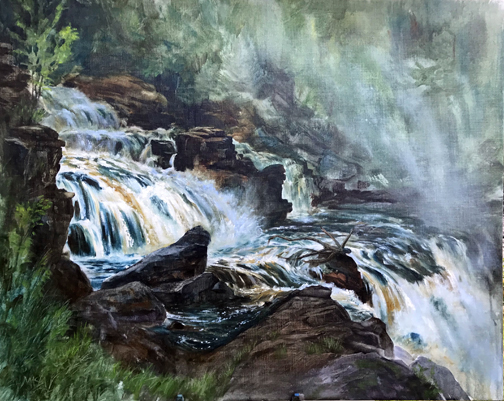 | "Her Beauty and Power" (oil on linen, 24 x 30 in.) is a plein air painting done at the Saranac Lake Plein Air Festival in St. Regis Falls, Adirondacks, a few years ago. I have always felt an affinity for waterfalls – both awe at the raw power of nature and the sublime beauty and mystery they evoke. I tried to capture that in this painting. It was a cloudy day so I had the opportunity to work on it for 4 to 5 hours straight and bring it to a place where it felt complete while working on location.
| When I teach workshops I always emphasize how intention is the most important factor in the artistic process. It creates what I like to call "the energy field" of the piece and it is the foundation on which all other elements rest. From the choice of tools, medium and ground, to composition, values, tonal key, paint application, details, etc., a piece "works" when the various elements are in alignment with, (or at least don't detract from) the intention.
We have all seen works that may have great, admirable, and technical prowess but perhaps lack a certain something that propels them from the ordinary to the extraordinary – I am certainly responsible for creating my fair share of these. In fact, all artists do. It is part of the process of being an artist, and of course, is related to intention.
It is a real paradox of the artistic journey that we have to learn and master our craft in order to transcend it. To create extraordinary works that have the power to move most people is actually quite rare. This statement is not said with the design to establish a hierarchy of work but rather to emphasize the importance of intention within the creative process and the role of improvisation.
It doesn't matter whether your intention is "I want to just play with color, push it around and see what happens" or, "I want to capture the feeling for this landscape using a composition based on the golden section in a high key that is uplifting and moves people to feel joyous." It's your intention and there are no mistakes, only opportunities that show you where you are in relation to your intention. These opportunities for change and growth all contain something revealing – perhaps unique and beautiful in their own way – the wabi-sabi nature of things, the perfection of imperfection.
These so-called "mistakes" can be our greatest teachers. This is the basis of real critique, not to be mistaken or exchanged for criticism. By understanding our intention, we can understand where we are and where we are going and thus determine what we need to do. From my perspective Art is not a noun, it is a verb – a way of Being, a way of life.
Each week during the winter when running workshops at Casa de los Artistas, my retreat center in Mexico, we take a boat trip to explore the gorgeous Pacific coastline and stop for a picnic lunch on the beach. It is a wonderful opportunity to study the sea, rock formations, and the effects of atmospheric perspective. During the picnic, I will often do a short demo on the "anatomy of water and waves," pointing out some key underlying features to look for.
When painting water, we need to decide what particular aspect of energy we want to convey; stillness, movement, rocking, soft or forceful, falling or crashing. What is the intention? Do we wish to "freeze" a moment in time or show a sense of continual movement?
Every element and object has a unique energy field. When drawing or painting any representational thing, particularly en plein air, close observation and the execution of good craftsmanship is 90 percent of the process. Craftsmanship is developed through time spent learning the properties of a given medium and practicing the process of drawing and painting; line, shape, composition, values, color, edges, detail, etc. The other 90 percent of the process of manifesting your intention is giving yourself permission to infuse the work with passion and improvisation. | 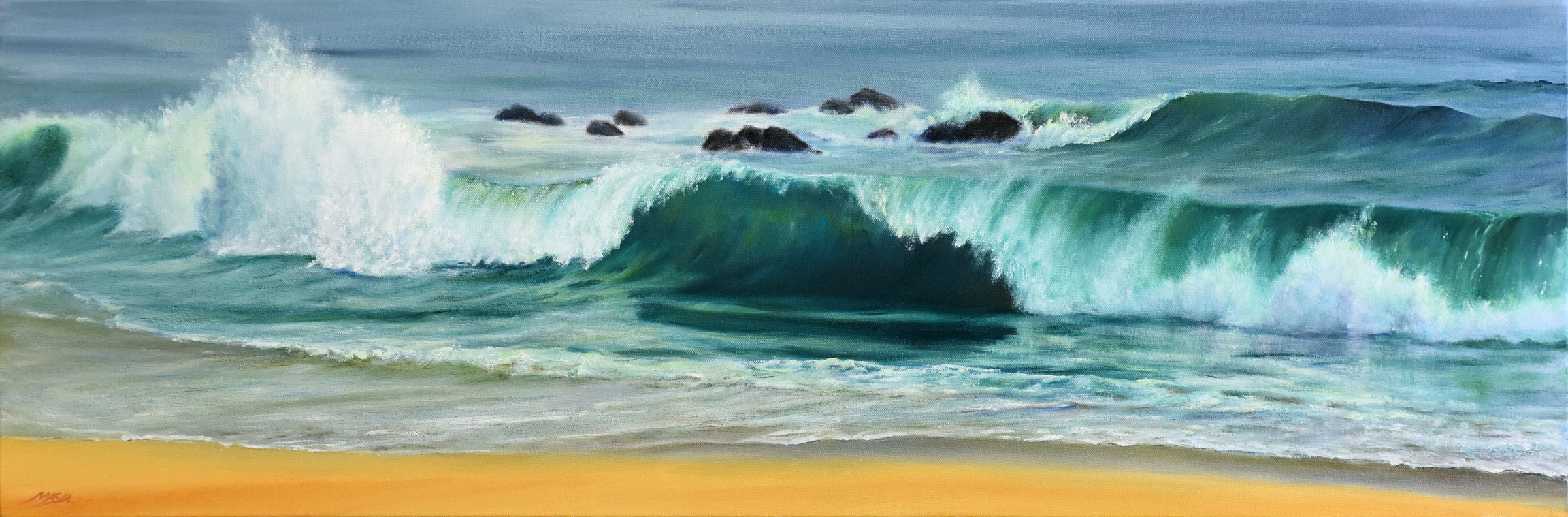 | "The Sound of Surf," oil on canvas, 12 x 36 in. This is a studio piece done from photos and studies in Mexico. I sought to capture the moment(s) of the crashing wave when the surf roars.
| 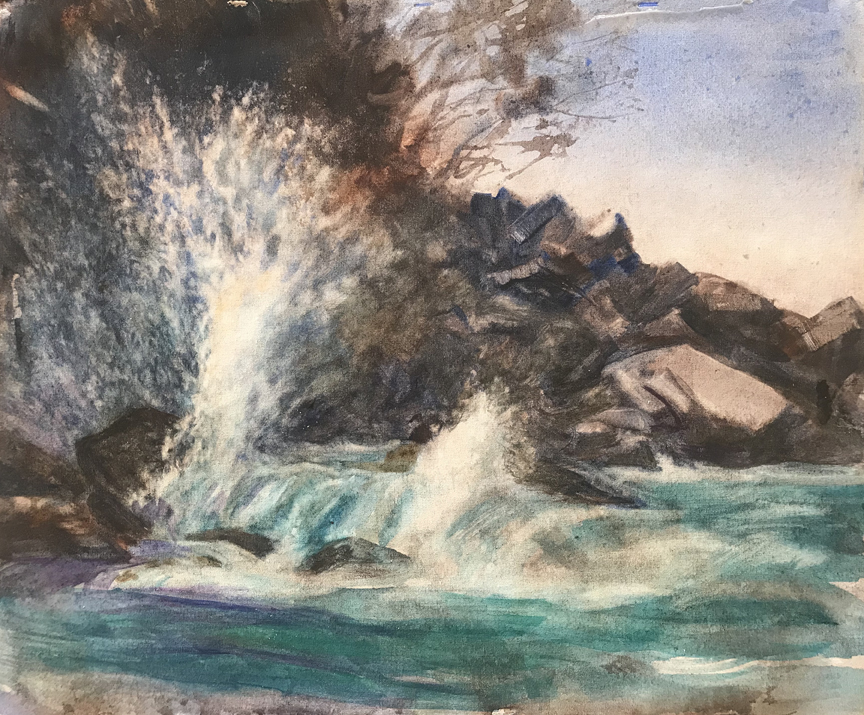 | "Crashing Light," watercolor on Fredrix watercolor canvas, 18 x 24 in. Done at an evening demo from memory at the Casa after the day's boat trip. In a painting demo, there may be multiple intentions. Here my intention was to demo the use and properties of watercolor canvas as well as some of the properties of a crashing wave while working eidetically (from mind and memory). The improvisational nature was facilitated using an imprimitura technique with watercolor on watercolor canvas as the painting unfolded spontaneously with no real preconceived plan other than the image in my head.
| — advertisement — |  | Your passion is connected to your personal vision of yourself and the world. It is linked to your improvised intuitive response of imagination, emotion, and memory. This ability of an artist to apply and combine all that they have learned and practiced about the medium and processes, coupled with a spontaneous, improvised response to the current moment that is filled with a passion-fired imagination, is where creativity lives.
| 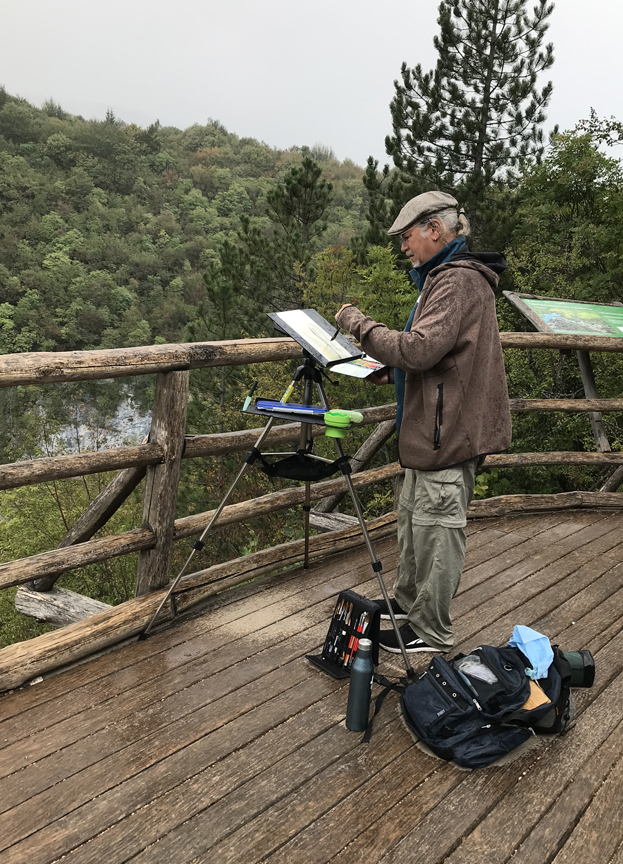 | My wife Monica and I just recently returned from traveling in Croatia and the surrounding regions. We spent one day hiking around Plitvicka Lakes National Parks with its dozens of waterfalls. After hours of hiking with no room to set up on the trails to paint, we came to a large enough look-out deck across a gorge from the tallest of the waterfalls. I set up my en Plein Air Pro easel and was getting the first wash complete when it started to rain for about 10 minutes – probably improved my painting as it forced me to work most of the piece wet in wet-in-wet, literally!
| In trying to master our craft, sometimes over time we can find ourselves becoming its servant. Mastering a craft does require patience, practice, and persistence, but too often we can fall into simply using what is tried and true, predictable and safe. The longer we do this, the more challenging it is to infuse permission, passion, and improvisation into our work. I think this is a common dilemma.
| 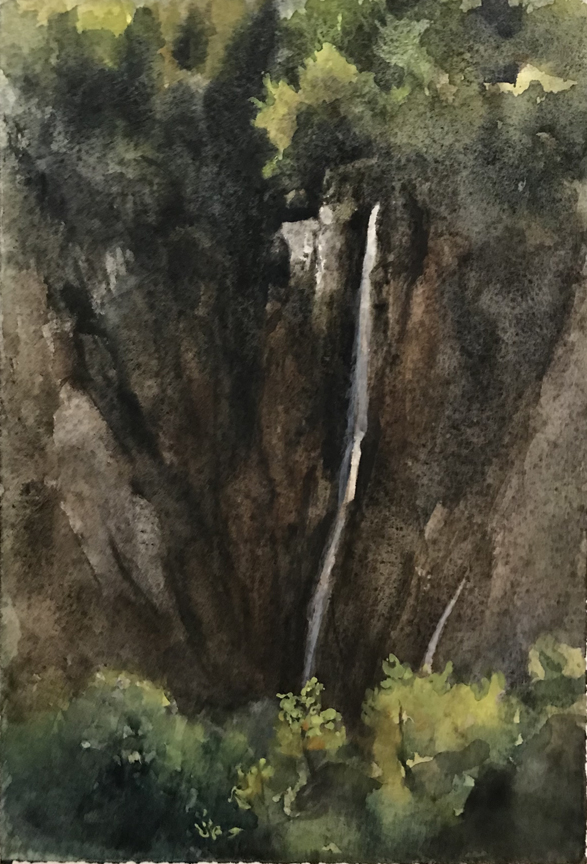 | In painting what was a dramatic view across the gorge, I wanted to capture the sense of its depth and the gravity of the falling water as it plunged downward a great distance into the abyss. I was also experimenting with a set of Rembrandt granulating colors I had gotten just before leaving on the trip. I had a lot of fun with these along with the effects of the rain in creating the textures for "Dropping In (painting in the rain, Plitvicka, Croatia)," Rembrandt watercolor on Gemini cold press, 11 x 7.5 in.
| One of the hallmarks of creativity is improvisation. There are many exercises, situations, and tools that can help facilitate this process and I try to introduce these in my workshops when appropriate. One way I always tell painters to catapult this process (of course) is by painting en plein air. Its very nature is one that can easily facilitate improvisation as there are so many unknown and uncontrollable factors and variables that must be dealt with in the moment. Another method is switching materials or techniques to ones that are unfamiliar and forcing experimentation, or changing your typical work environment is also helpful. Painting moving water is unpredictable in itself, thus giving us the opportunity to improvise. | 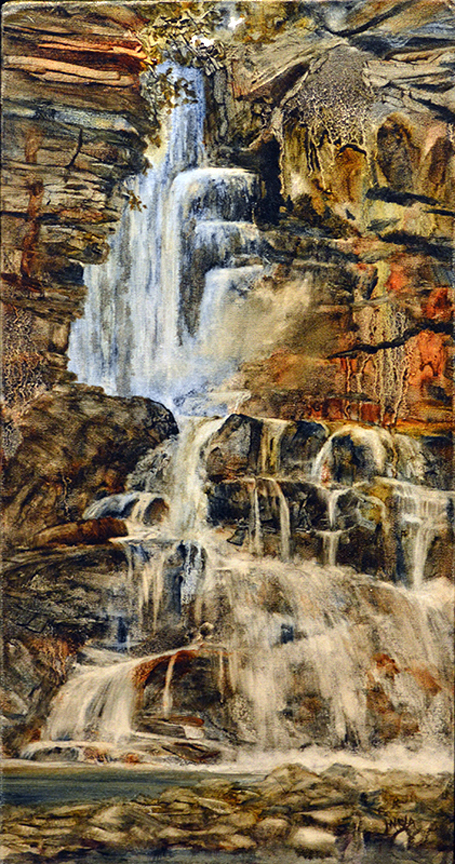 | "High Falls" (oil on Fredrix all media canvas paintboard, 16 x 8 in.). I painted this piece a few years ago when I was with Eric Rhoads at his plein air painters Publisher's Invitational in the Adirondacks. I was experimenting with using thinner mixed with various painting mediums, trying to capture the abstract quality of the water as it flowed through the various patterns of textured rocks in a hide-and-seek.
|
|
|
|
What is your intention? For me, the overarching intention of Art is the process of being present and aware and responding to the moment with imagination, creativity, and compassion. | — advertisement — |  | Just Go Looking | 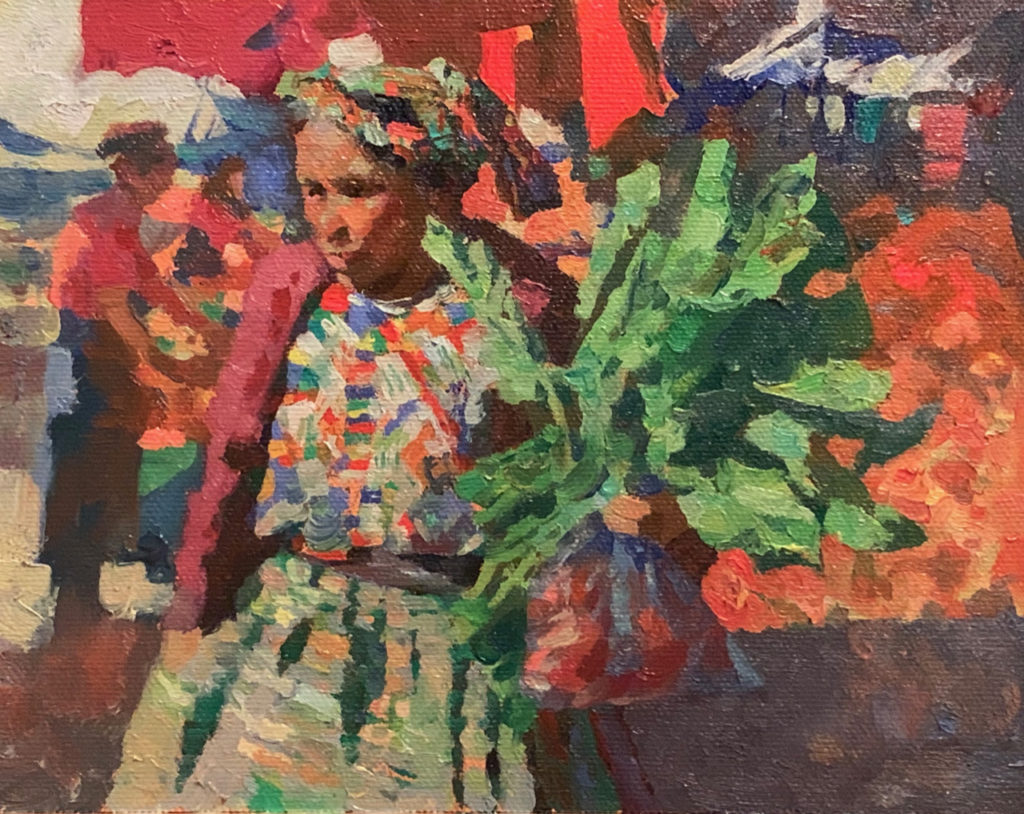 | Kevin Macpherson, "Flower Seller, Guatemala," 2020, oil, 6 x 8 in., Private collection, Studio
| Plein Air Inspiration in a Minute
"When I go out, I don't think 'mountains' or 'beach'; I just go looking. I let my eyes wander and accept shapes and colors that combine to form inspiring abstract compositions. Those abstract shapes host reality."
— Kevin Macpherson
("Beyond the Paintbrush," PleinAir® Magazine, Aug-Sept 2020)
More from Kevin Macpherson:
Compositionally I am stimulated by natural impressions. For example, a simple rock inspires me to see endless unexpected 3-D compositions. The rock will spur my imagination to see things I could not even imagine, and the same goes for the composition of a landscape painting. You could have 368 paintings all of the same subject, all different compositions, all different light and atmosphere effects captured with the three colors I use. The arrangements and harmonies my mind could not invent, but if I am consciously aware and awake to see these natural phenomena I can create endless unique compositions.
Why do I do it? Because I have no other skills! It is truly the only thing I ever thought of doing and if I don't create every day I feel restless and incomplete. I believe it is my purpose in life to see and accept the stimulation that comes to me and also be able to share that with others in the many forms of the actual artwork and my opportunities to teach others to see. To teach one to see and learn the visual language of an artist can truly change one's life for the better.
This Just In:
Artist Kevin Macpherson is about to change the way you paint — and see — forever! And the best part … your paintings are going to improve. The first in a new series of videos from Kevin, this video is going to immerse you in Kevin's Magic Grid system so your painting life can become easier and more fun. With over 40 years of painting experience and as the author of four art books and several art instruction videos, Kevin is here to guide you through his painting process and take your art to the next level.
Preview Kevin's art workshop, "The Magic Grid: Landscapes," here: | 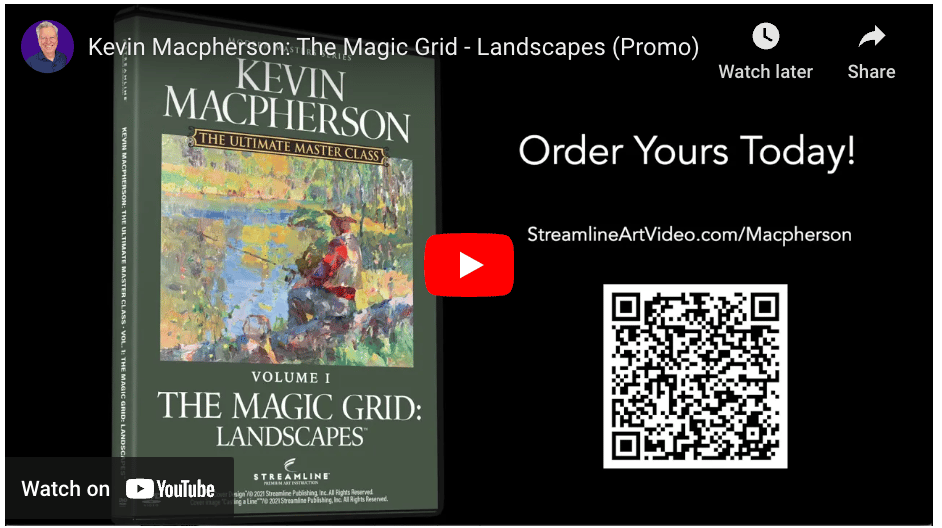 | Learn more about painting landscapes with Kevin Macpherson by clicking here. |  | — advertisement — |  |
|
| | |
|
Plein Air Today is committed to protecting and respecting your privacy. We do not rent or share your email address. By submitting your email address, you consent to Streamline Publishing delivering regular email issues and advertisements. To end your Plein Air Today e-mail subscription and associated external offers, unsubscribe here. To learn more about Streamline Publishing events, products, and offerings visit StreamlinePublishing.com
Copyright 2023 Streamline Publishing, Inc. All rights reserved.
PleinAir® Magazine and Plein Air Today® are registered trademarks of Streamline Publishing, Inc. |
|
|
|
|


Comments
Post a Comment